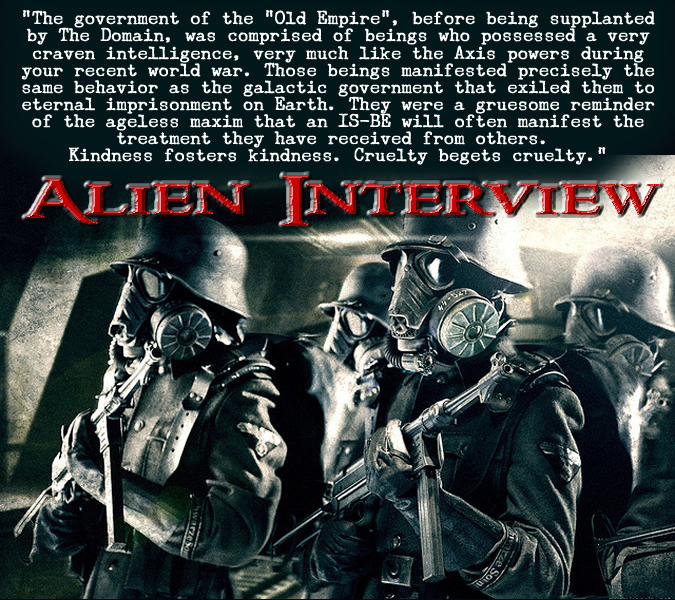
 “The government of the “Old Empire”, before being supplanted by The Domain, was comprised of beings who possessed a very craven intelligence, very much like the Axis powers [i] (Footnote) during your recent world war. Those beings manifested precisely the same behavior as the galactic government that exiled them to eternal imprisonment on Earth. They were a gruesome reminder of the ageless maxim that an IS-BE will often manifest the treatment they have received from others. Kindness fosters kindness. Cruelty begets cruelty. One must be able and willing to use force, tempered with intelligence, to prevent harm to the innocent. However, extraordinary understanding, self-discipline and courage are required to effectively prevent brutality, without being overwhelmed by the malice that motivated the brutality.
Only a demonic, self-serving government would employ a “logic” or “science” to conceive that an “ultimate solution” to any problem is to murder and permanently erase the memory of every artist, genius, skilled manager, and inventor, and cast them into a planetary prison together with political opponents, killers, thieves, perverts, and disabled beings of an entire galaxy!
Once the IS-BEs expelled from the “Old Empire” arrived on Earth, they were given amnesia, and hypnotically tricked into thinking that something else had happened to them. The next step was to implant the IS-BEs into biological bodies on Earth. The bodies became the human populations of “false civilizations” which were designed and installed in the minds of IS-BEs to look completely unlike the “Old Empire”.
All of the IS-BEs of India, Egypt, Babylon, Greece, Rome, and Medieval Europe were guided to pattern and build the cultural elements of these societies based on standard patterns developed by the IS-BEs of many earlier, similar civilizations on “Sun Type 12, Class 7” planets that have existed for trillions of years throughout the universe.
In the earliest times the IS-BEs sent to prison Earth lived in India. They gradually spread into Mesopotamia, Egypt, Mesoamerica, Achaea, Greece, Rome, Medieval Europe, and to the New World. They were hypnotically “commanded” to follow the pattern of a given civilization by the “Old Empire” prison operators. This is an effective mechanism to disguise the actual time and location from the IS-BEs imprisoned on Earth. The languages, costumes and culture of each false civilization are intended to reinforce amnesia because they do not remind the IS-BEs on Earth of the original “Old Empire” planets from which they were deported.
On the very far back-track of time these types of civilizations tended to repeat themselves over and over because the IS-BEs who created them become familiar with certain patterns and styles, and stayed with them. It is a lot of work to invent an entire civilization, complete with culture, architecture, language, customs, mathematics, moral values, and so forth. It is much easier to replicate a copy based on a familiar and successful pattern.
A “Sun Type 12, Class 7” planet is the designation given to a planet inhabited by carbon-oxygen based life forms. The class of the planet is based on the size and radiation intensity of the star, the distance of the planetary orbit from the star, and the size, density, gravity, and chemical composition of the planet. Likewise, flora and fauna are designated and identified according to the star type and class of planet they inhabit.
On the average, the percentage of planets in the physical universe with a breathable atmosphere is relatively small. Most planets do not have an atmosphere upon which life-forms “feed”, as on Earth, where the chemical composition of the atmosphere provides nutrition to plants, and other organisms, which in turn support other life forms.”
FOOTNOTES:
[i] “… like the Axis powers…”
“The Axis powers, also interpreted as Axis alliance, Axis nations, Axis countries or sometimes just the Axis were those countries opposed to the Allies during World War II. The three major Axis powers, Nazi Germany, Fascist Italy, and Imperial Japan were part of a military alliance on the signing of the Tripartite Pact in September 1940, which officially founded the Axis powers. At their zenith, the Axis powers ruled empires that dominated large parts of Europe, Africa, East and Southeast Asia and the Pacific Ocean, but World War II ended with their total defeat. Like the Allies, membership of the Axis was fluid, and some nations entered and later left the Axis during the course of the war.
The term was first used by Benito Mussolini, in November 1936, when he spoke of a Rome-Berlin axis arising out of the treaty of friendship signed between Italy and Germany on October 25, 1936. Mussolini declared that the two countries would form an “axis” around which the other states of Europe would revolve. This treaty was forged when Italy, originally opposed to Germany, was faced with opposition to its war in Abyssinia from the League of Nations and received support from Germany. Later, in May 1939, this relationship transformed into an alliance, called by Mussolini the “Pact of Steel”.”
— Reference: Wikipedia.org
Originally posted 2012-06-03 23:36:26. Republished by Blog Post Promoter